
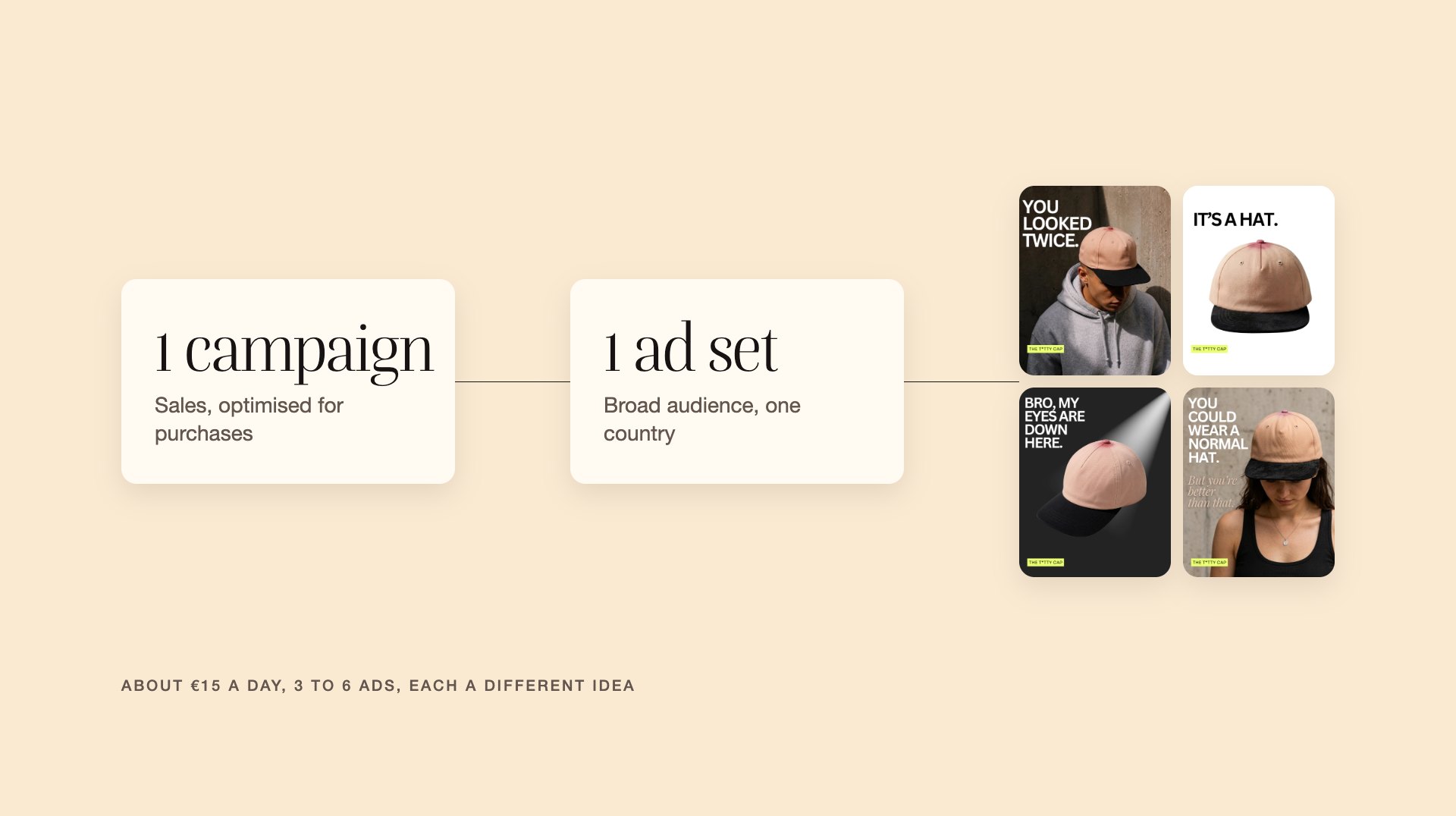
A small Meta ads budget works if you stop running it like a big one. Most small accounts we open have their money split across so many campaigns and ad sets that nothing gets enough spend to tell you anything. This is how we set up an account spending about €15 a day, and the checklist we run before anything goes live.
What counts as a small budget?
For this post, anything under about £50 or R1,000 a day. There's a line at all because of how Meta learns. Each ad set has to collect results before its delivery settles down, and the figure Meta gives is around 50 results a week.
At €15 a day you have €105 a week. Unless a sale costs you about €2 in ads, you'll not reach 50. So a small account spends most of its life short of data. You can't fix that. You can avoid making it worse.
Use one campaign and one ad set
Split €15 a day across three ad sets and each one gets €5. The ads inside them get cents. A week later you have three ad sets that made one sale or none, and no idea which message worked.
Put the whole budget in one ad set and every euro teaches Meta about the same audience. You also get one clean list of ads, ranked by what they sold.
We add a second ad set in two cases. The first is when the product has two completely different buyers, such as people buying for themselves and people buying a gift. The second is when there are two very different offers and one would take all the spend. Even then, the budget has to be able to feed both.
Tell Meta you want sales
Choose the Sales objective and optimise for purchases. A traffic campaign finds people who click. An engagement campaign finds people who like things. Neither is looking for buyers, which is why a boosted post can get plenty of clicks and no sales.
Check the tracking before launch. Place an order, or wait for a real one, and confirm it shows as a Purchase event in Events Manager. If Meta can't see the sales, it can't look for more of them.
Make one offer, and say it plainly
A small budget can't afford to explain your brand slowly over six weeks. The ad has to make sense in the second someone gives it. Lead with the product that already sells best, and avoid the temptation to advertise the stock you want to clear.
Then say what the deal is. "Soy candles" is a category. "Buy three, get one free this week" is an offer.
Count ideas, not files
A novelty hat brand we work with had 21 static ads ready to load. When we sorted them by idea, there were 9. The rest were the same picture with a different crop or one line of text changed.
Meta decides who sees an ad mostly from what's in it, so 5 copies of one picture give it 1 thing to test. On €15 a day they also share out money that one ad needed. So we run 3 to 6 ads, and each one gives a different reason to buy. Working out those reasons is creative strategy, and it has its own post.
When one ad wins, make more like it. On this account a single video of the founder wearing the hat did nearly all the selling, so we rebuilt the product page to sound the way he does in it. The account returned three times what it spent, and the case study has the page.
Keep the targeting broad
Pick the country. Add an age range only if the product needs one. Leave interests alone. If the product is for new mums, or for people who fish, say so in the ad. The people it's not for scroll past, and Meta follows the ones who stop.
Leave it alone for a week
New ads are jumpy. One good day followed by one bad day means nothing yet. We give a new set-up five to seven days before changing anything that matters, and longer when the budget is very small.
Every edit also muddies the result. If you changed the budget on Tuesday and swapped an ad on Thursday, you'll not know which one moved the numbers. Between reviews we only check that it's spending and that orders are coming through.
The checklist before launch
- The objective is Sales, optimised for purchases.
- A real order has shown up as a Purchase event.
- Every ad carries the same single offer.
- There's one campaign and one ad set, or a written reason for a second.
- There are three to six ads and each is a different idea.
- The audience is broad.
- The review date is in the diary, a week out.